Posted on: March 30, 2026 | Author: Admin
3 min Read
Virtual Reality Game Development: The Major Trend in Modern Gaming
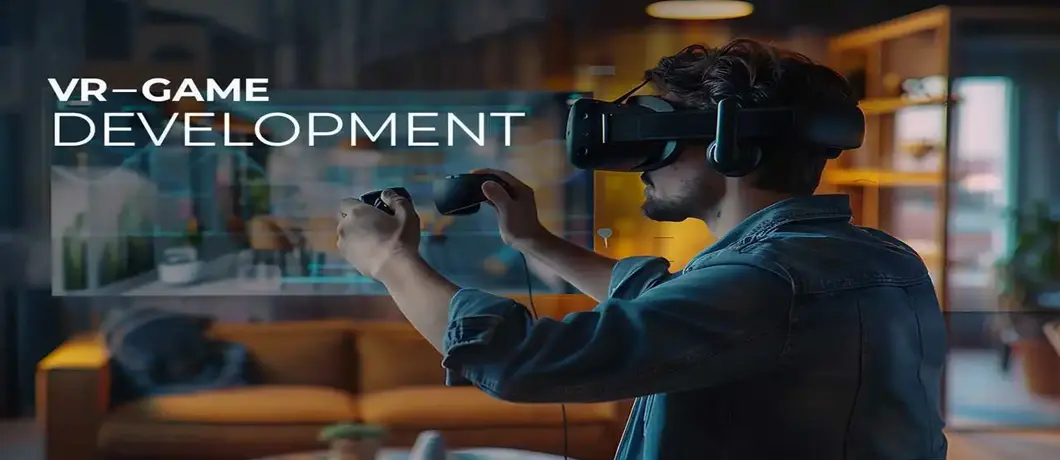
How would you feel to be able to get into the game you have always loved and not look at it on a screen? It is the strength of virtual reality games development, a new movement redefining the gaming industry. With the explosion of digital entertainment taking the world by storm, it has become a fast-moving trend that is transforming into a trademark, one that is establishing the new frontiers of internet immersion and interactivity in the future of video games.
Fortune Business Insights predicts that the VR Gaming Business is estimated to expand by the year 2024 to around $22.63 billion, and increase to $189.17 billion by the year 2032.
This tutorial offers a lucid overview of this disruptive area and details how immersive virtual worlds are altering the interaction, engagement, and community formation process of individuals.
What is Virtual Reality Game Development?
The development of Virtual Reality (VR) games is the process of developing an interactive environment of three-dimensional games using not only dedicated programs but also hardware, such as headsets and motion controllers.
In contrast to the classic video games, where the game is played on a flat screen, VR games are played with the help of special equipment, such as headsets, controllers, and spatial audio, therefore, ensuring the feeling that the players are in the game.
Benefits of VR Game Development
1. High Level of Immersion
Virtual Reality is entirely immersive because the players can be placed inside a 3D setting. This makes it a more interactive gaming experience and has a greater emotional attachment than conventional games.
2. Better Learning and Training
Virtual games based on simulation are popular in the medical field, the airline industry, and the military. They enable the users to learn by doing and enhance their retention and practical learning.
3. Encourages Innovation
An immersive gaming experience opens new gameplay opportunities by allowing motion detection, the ability to interact in space, and movement in the real world. This gives it the potential to be innovative, which cannot happen in conventional game creation.
4. Opportunities to grow the market
The demand among the developers, designers, and content producers is open because the VR Gaming business is growing at a very rapid pace. This provides a business and a good career.
5. Increased Social Interaction
VR Users interact with each other in the virtual worlds of the multiplayer VR game experiences. They can talk with one another and use their hands to communicate with one another.
6. Applications Beyond Gaming
The skills applied in the creation of VR games can be applied in other industries, like:
- Healthcare
- Education and training
- Architecture and real estate
- Virtual exploration and tourism
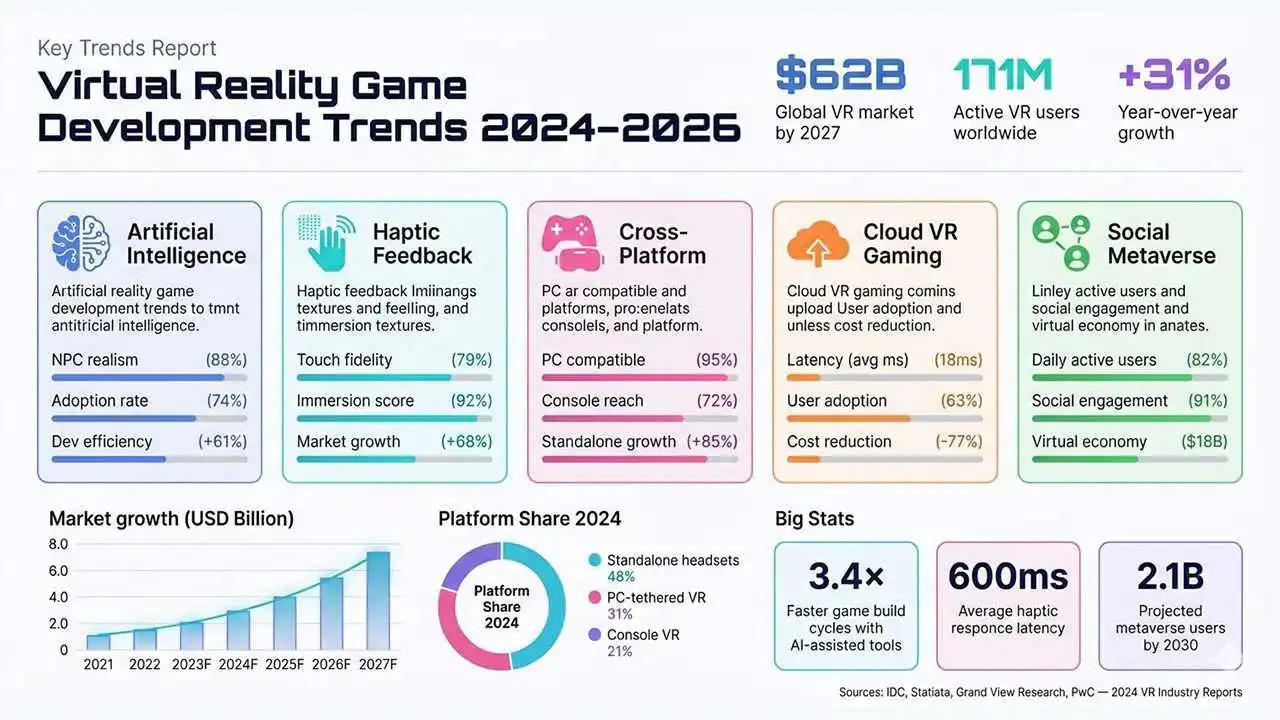
Key Trends in Virtual Reality (VR) Game Development
Virtual reality (VR) games are founded on innovation. The strong forces within the industry include:
Key Points:
- ✓ Artificial Intelligence: AI is being incorporated to enhance the behavior of the NPC, and adaptive narratives to enable the game to play like a human being.
- ✓ Haptic Feedback: The next generation of haptic and Immersive technology allows individuals to touch objects and experience virtual worlds.
- ✓ Cross-Platform Compatibility: PC, Consoles, and the standalone device can cross-play a range of new VR games.
- ✓ VR gaming online: Streaming removes the hardware limitations, and users can have access to high-quality VR experiences with very little setup.
- ✓ Social metaverses: VYUG Metaverse and other socializing and gaming apps enable users to share and have a digital world that persists.
Challenges In Virtual Reality Game Development
Although the creation of virtual reality games opens some very promising opportunities, it also has its problems:
- ✓ Resource Requirement: The development of advanced VR games demands professional talents, teams, and technologies.
- ✓ Performance and Accessibility: It is an issue of high performance, low latency, and low motion sickness, which is still underway.
- ✓ Content Innovation: Developers should turn to new mechanics and new player experiences all the time.
These issues, in their turn, provide progressive studios with ample prospects to become the next generation of gaming innovations.
Essential Tools for Creating VR Game Development
To create a strong, interesting, and winning Virtual Reality game, it is necessary to resort to an array of advanced tools and technologies of the next generation. Some of the developers' most often used are discussed below:
Unity 3D
One of the most widespread engines for the creation of VR games is Unity 3D , with its cross-platform compatibility and high flexibility. It allows developers to create, test, and distribute VR games on a large collection of devices.
Unreal Engine
Unreal Engine is a complete photoreal graphics engine with a very powerful VR game development platform. It works with Blueprint Visual scripting systems that allow the company to do prototyping at a quicker pace without necessarily having to compose a lot of code, and Lumens and Nanite provide finer textures and authentic lighting.
Blender
Blender is a free software that is used to create 3D animation and design animated figures and objects for games. The packages cover a large number of tasks, including rigging and sculpting, rendering, texturing, and others.
Virtual Reality Toolkit (VRTK)
The toolkit provides simplified VR development solutions to the users of Unity because it comes partly equipped with hand tracking, teleportation, locomotion, and interaction features, therefore, requiring less time to develop.
Why Choose VYUG Metaverse for VR Game Development?
As a leading game development company, we have provided VR Game Development Solutions to the industry since we have unmatched expertise in developing high-performance, immersive gaming experiences. Game developers who have vast experience in using Unreal Engine, Unity 3D, and AR / VR Integration, and others, can be hired.
Our games are developed and optimized to work with various devices, such as HTC Vive , Oculus , PlayStation VR , etc. Whether it is in 3D modeling, concept development, coding, testing, or deployment, we have it all in our end-to-end game development solutions. To come up with a very interactive gaming experience and a successful game, VYUG Metaverse continuously concentrates on intuitive controls, realistic environments, and interesting gameplay, among others.

V1: Turbo Track is a VR (Virtual Reality) racing game that has been created within the banner of VYUG Playspace. This game places you in the cockpit of fast cars and takes you on a race in full 360 VR multi-track environments.
Conclusion
Virtual Reality Game Development is the signpost of an exciting shift in interactive entertainment. With ever-changing immersive technology and the ever-growing assortment of content, VR is set to become the norm for gamers of the present and in the future. VYUG Metaverse, the VR game development platform , allows partners, developers, and players to create virtual reality games.
Faq’s
Was this helpful?

Leave a Reply
Your email address will not be published. Required fields are marked *
User Comments
Related Articles
Virtual Try-On Solutions: A Game Cha...


Virtual Reality (VR) in Real Estate:...

Virtual Sustainable Living: Alternat...
Newsletter Sign-up
